
The ART process is an ordeal for patients and couples alike, but fortunately they are not alone in this adventure. For some years now, emphasis has been placed on the importance of multi-disciplinary teams to support patients at every stage of their journey, which is full of pitfalls and twists and turns. With the help of psychologists and nutritionists, support goes even further, to control as far as possible the impact of treatment on the daily lives and health of patients and their couples.
To better understand the mental health implications of ART, we meet with Lou Exposito, a clinical psychologist who works with the team at Les Bluets, a leading ART center in Paris.
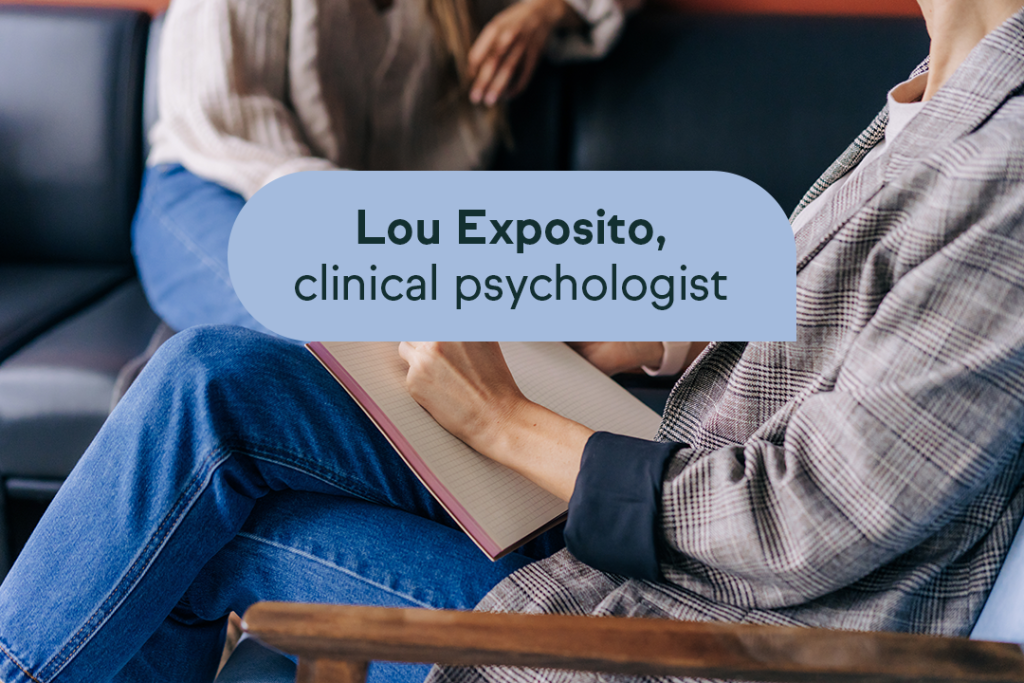
Thank you for your time. Could you start by introducing yourself and your background?
I work in ART and sexual health centers and I also work in private practice. As a clinical psychologist by training, I use all possible forms of therapy depending on the person in front of me.
I first worked in a maternity unit at Trousseau Hospital, then at the family planning center, where I inevitably met people going through the ART process. They lacked support and it was quite natural for me to take an interest in their lives. In fact, it was Dr Lédée who supported the increase in the time spent by psychologists with ART patients. I then read a lot on the subject, and became very interested in gamete donation, the different stages of ART, IVF and all the associated life events.
How did you come to specialize in supporting couples undergoing ART?
It’s complicated because it’s not medicine that cures, but medicine that helps women and couples to have a child. Couples undergoing ART have to battle with emotional ups and downs, feelings of injustice, and sometimes clumsy relatives or doctors.
There’s a lot of guilt involved in this process, which can be very long. People often arrive at the start of ART with the impression that it’s the end to all conception problems and that it’s the magic solution that will succeed in just a few months. Couples don’t expect it to be a real journey with real medical and psychological complexities.
How does psychological support work in ART programmes?
It depends on the service: Dr Lédée and the Bluets have always emphasized support, with a caring approach. But it’s not always easy, because ART procedures are extremely medicalised, and medical time is not elastic; it can’t really be devoted to anything other than explaining the procedure or performing medical procedures.
It’s not that the doctors don’t want to, they put their time and energy into optimizing medical care, and it’s hard to see the psychological impact when it’s not experienced from the inside.
The lives of patients and couples are turned upside down. Every day is a challenge and time is now divided into cycles. Every injection, every blood test, every medication, every run to the monitoring: it’s an invasive journey. Doctors can’t see everything and can’t always be aware of it.
How do you rate the importance of mental health in the ART process?
This should be a systematic part of care, in one form or another, but generally speaking, there is a huge lack of support. We offer discussion groups and a whole range of things, but not everyone wants to see a psychologist. Most people who see a psychologist during ART are there because they can’t take it any more. This should be set up beforehand, so that we fully understand what is involved in the long term and in the construction of the couple and their intimacy.
At what stages do you intervene?
Often when it’s already a little too late, when patients are already in great pain and they’ve broken down, or at the end of the treatment to help them through bereavement or gamete donation.
But things are starting to change: today I see couples and women earlier in the treatment process, and that’s great. At Les Bluets, it’s very easy for doctors to refer patients to shrinks, because they’ve realized that we’re there to provide support, not psychoanalysis.
Is personalized care, in terms of both technical procedures and mental health care, essential today?
That’s really what we’re trying to do at Les Bluets, everyone is very involved and it’s great to see. Of course, the more we can personalize care, the better it is experienced.
As with psychological treatment, the test is used as a last resort. Of course, it’s not always advisable, as in the case of patients whose reflex is to want to undergo IVF straight away before investigating other options, but it’s certainly worth raising awareness of.
With both the test and the personalized mental health support, patients understand what’s going on. The explanations are clear, time is taken, they feel concerned and heard, and not just subjected to medical orders.
What are the best ways to support your ART journey?
In my opinion, it’s absolutely essential to work with a sexologist: sexuality is the first thing to go wrong when it’s associated solely with the need to procreate. Secondly, a team of sympathetic doctors is enough! If you have the psychological support that goes with it, things should go well, despite any medical problems or setbacks.
Why consult a psychologist when undergoing ART?
ART itself generates tensions that we can’t resolve on our own. For example, it generates guilt in the man (everything happens in his partner’s body, he sees her suffering alone for the couple’s project and can’t do much about it. A feeling of powerlessness that men are not fans of!)
In women, there’s often a need for a little control in a situation where everything seems to be slipping away from them, and a desire for their partner to be both very understanding and solid: he needs to feel things the way she does, or even guess at them, and as this is rarely the case, she can sometimes resent him. And if he’s too sensitive, she may reproach him for not being able to count on him. The other person is never at the right distance, and as soon as intimacy is linked to procreation, it’s appalling. Making love on command or masturbating in a small, creepy place because it’s the day of the puncture often creates tension and damages the couple’s intimacy, which is dramatic.
We don’t work on the personal histories of each person, but provide support to help them find their way. That’s more how I see the support provided by psychologists in ART teams. In my consultations today, I see a few couples and a few men, but I mainly see women.
Is science a bulwark against false hope or blissful optimism?
Couples often look for a lot of information on their own, but the problem is that they can try to put on other people’s costumes. Sometimes they come and say “such and such a couple did this, I’ve heard that”, but each couple, each person, is unique and not everything applies so easily to everyone. Nevertheless, in the dynamics of the journey, it’s essential and reassuring to have examples and advice. That’s why we set up the discussion groups. In many cases, the people who meet there continue to talk to each other and support each other.
As far as patients are concerned, hope plays a huge, central and daily role, which opens the door to possible abuses that we have to be wary of (alternative medicines, sellers of pseudo-magical products or therapies, etc.).
There’s a kind of injunction to positive thinking and magical thinking that gives an illusion of control: “If it didn’t work this time, it’s because I didn’t believe in it enough (or I was too stressed, not positive enough, etc.), so it’s up to me to do better next time”. What guilt this kind of thinking generates! We negotiate with this infantile remnant of magical thinking, but it’s not true: if a pregnancy is meant to last, it will and no thought has any influence on it.
Nothing other than the medical really helps couples undergoing ART. The rest is important because it has an impact on quality of life, but it’s not a determining factor in the success of the process. What works is medicine, science and research.